Unlearning: Why Growth Sometimes Requires Letting Go
Unlearning: Why Growth Sometimes Requires Letting Go
“I think I finally understand what you’re teaching,” the learner said.
The facilitator smiled. “Tell me.”
“I need to learn a better way.”
The facilitator paused. “Maybe.”
“Maybe?”
“Sometimes you don’t need to learn something new. Sometimes you need to stop doing what you already learned.”
That distinction lies at the heart of the SWEET Institute.
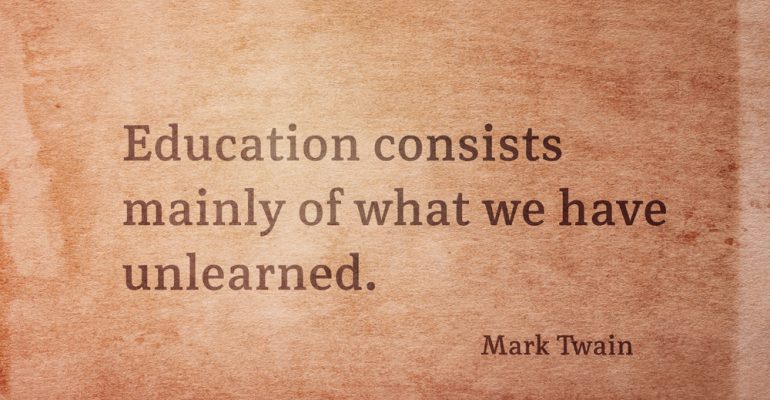
We often think of education as accumulation. We read another book, attend another seminar, earn another certificate, learn another framework, and add another technique to an increasingly crowded intellectual toolbox. We think we need more knowledge, more skills, or more information.
Yet human development does not always work through addition. Sometimes growth requires subtraction.
Sometimes before we can learn differently, we ought to recognize that something we already learned, perhaps years or even decades ago, is no longer serving us. We must unlearn.
That is much harder than simply learning something new. A new idea enters relatively open territory. Unlearning must compete with something already established: a habit, an assumption, an emotional response, a professional norm, or perhaps even an identity.
This is why the SWEET Institute does not speak only about learning. We speak about unlearning, relearning, and continuous learning. Together, they form a fundamentally different relationship with education.
Consider a clinician who was trained, implicitly or explicitly, to believe that expertise means having answers. During training, quick formulation was rewarded. Diagnostic precision was rewarded. Decisiveness was rewarded. Over time, the clinician became extraordinarily knowledgeable.
Then they began working with people whose lives did not fit neatly into diagnostic categories. The clinician knew more than ever. Yet something was not working. Patients nodded but did not engage. Recommendations were clinically sound but often went unused.
During a SWEET learning experience, someone asked, “What if your expertise is not the problem?” Then came the second question: “What if the way you learned to use your expertise is?”
That question required more than acquiring another technique. It required unlearning.
The clinician began examining a deeply embedded assumption: If I am the expert, I should know what the other person needs. Slowly, another possibility emerged: Perhaps expertise is most powerful when it helps us become more curious, not more certain.
Nothing had been taken away from the clinician’s knowledge. Yet their relationship to knowledge had changed. That is unlearning.
Research on transformative learning has long emphasized the importance of critically examining assumptions that organize how adults interpret experience (Mezirow, 2000). Conceptual-change research similarly demonstrates that prior conceptions can shape, distort, or resist new learning and may need to be reorganized for deeper understanding to occur (Vosniadou, 2013).
This is especially important because much of what we need to unlearn once made sense.
A child who learned to remain silent in a volatile household may have developed an intelligent strategy for staying safe. Years later, that same person may struggle to speak during conflict. A professional who learned that mistakes lead to humiliation may become perfectionistic. A leader who learned that vulnerability equals weakness may struggle to ask for help. A clinician who learned that competence means certainty may become uncomfortable saying, “I don’t know.”
These patterns are not necessarily irrational. Many were adaptations. Yet an adaptation that once protected us can eventually constrain us.
Unlearning therefore requires compassion. We do not simply ask, “Why am I doing this?” We also ask, “What purpose might this once have served?” Instead of attacking an old pattern, we understand it. Instead of shaming ourselves for having learned it, we become curious about why it developed.
And then we ask the question that makes change possible: Do I still need it? This is where unlearning becomes deeply experiential. It is one thing to intellectually recognize that an old belief is inaccurate. It is another thing to behave differently when the nervous system still expects the old consequence.
The old learning lives deeper than language. That is why unlearning cannot happen through explanation alone. It requires awareness, reflection, experimentation, repetition, feedback, and new lived experiences.
At SWEET, we might ask: What did you learn? Who taught it to you, directly or indirectly? Why did it make sense then? How does it show up now? When does it become activated? Where in your life is it still useful? And then what: what will you practice instead?
The SWEET Formula turns an old pattern into something that can be examined rather than something that simply controls us. This is the beginning of freedom.
Yet unlearning is only the first movement. After unlearning comes relearning. We intentionally develop another way of thinking, relating, deciding, or behaving. The person who learned silence can practice voice. The person who learned to fear mistakes can practice experimentation. The leader who learned to rely on control can practice trust. The clinician who learned to equate competence with certainty can practice curiosity.
And then comes continuous learning. No new understanding should become so sacred that we become incapable of questioning it.
We do not want learners simply to replace one rigid certainty with another. We want to cultivate people who can continue examining, revising, deepening, and integrating what they know throughout their lives.
The mature learner develops a different relationship with knowledge: “I learned it. I practiced it. I tested it. I continue to examine it. And when evidence, experience, or deeper understanding requires me to change, I am willing to learn again.”
Instead of intellectual instability, that is intellectual maturity. And perhaps it is one of the greatest forms of freedom education can offer.
One-Line Summary
Sometimes growth does not begin by asking, “What do I need to learn?” It begins by asking, “What am I finally ready to unlearn?”
SWEET CALL TO ACTION
This week, do not add another idea immediately. Instead, identify one belief, habit, assumption, or way of responding that you have carried for years.
Ask: Where did I learn this? What did it once do for me? What is it costing me now? What might become possible if I no longer needed it?
Do not rush to eliminate it. Understand it. Thank it for whatever purpose it once served. Then begin practicing what comes next.
If you are ready for education that does more than add information, education that helps you examine what you have learned, unlearn what no longer serves you, relearn with intention, and continue learning throughout your life, the SWEET Institute offers many pathways: one-hour series, two-hour seminars, certificate programs, weekend learning, live and self-study experiences, books and bibliotherapy, community, supervision, coaching, membership, and integrated learning packages.
Sometimes the next level of your growth is not hidden in something you have yet to discover. Sometimes it is waiting underneath something you are finally willing to let go.
Scientific References
- Kegan, R., & Lahey, L. L. (2009). Immunity to change: How to overcome it and unlock the potential in yourself and your organization. Harvard Business Press.
- Mezirow, J. (2000). Learning as transformation: Critical perspectives on a theory in progress. Jossey-Bass.
- Nystrom, P. C., & Starbuck, W. H. (1984). To avoid organizational crises, unlearn. Organizational Dynamics, 12(4), 53–65.
- Rushmer, R., & Davies, H. T. O. (2004). Unlearning in health care. Quality and Safety in Health Care, 13(Suppl 2), ii10–ii15.
- Vosniadou, S. (Ed.). (2013). International handbook of research on conceptual change (2nd ed.). Routledge.
- Wang, X., Qi, Y., & Zhao, Y. (2019). Individual unlearning, organizational unlearning and strategic flexibility. Management Decision, 57(5), 1187–1207.